
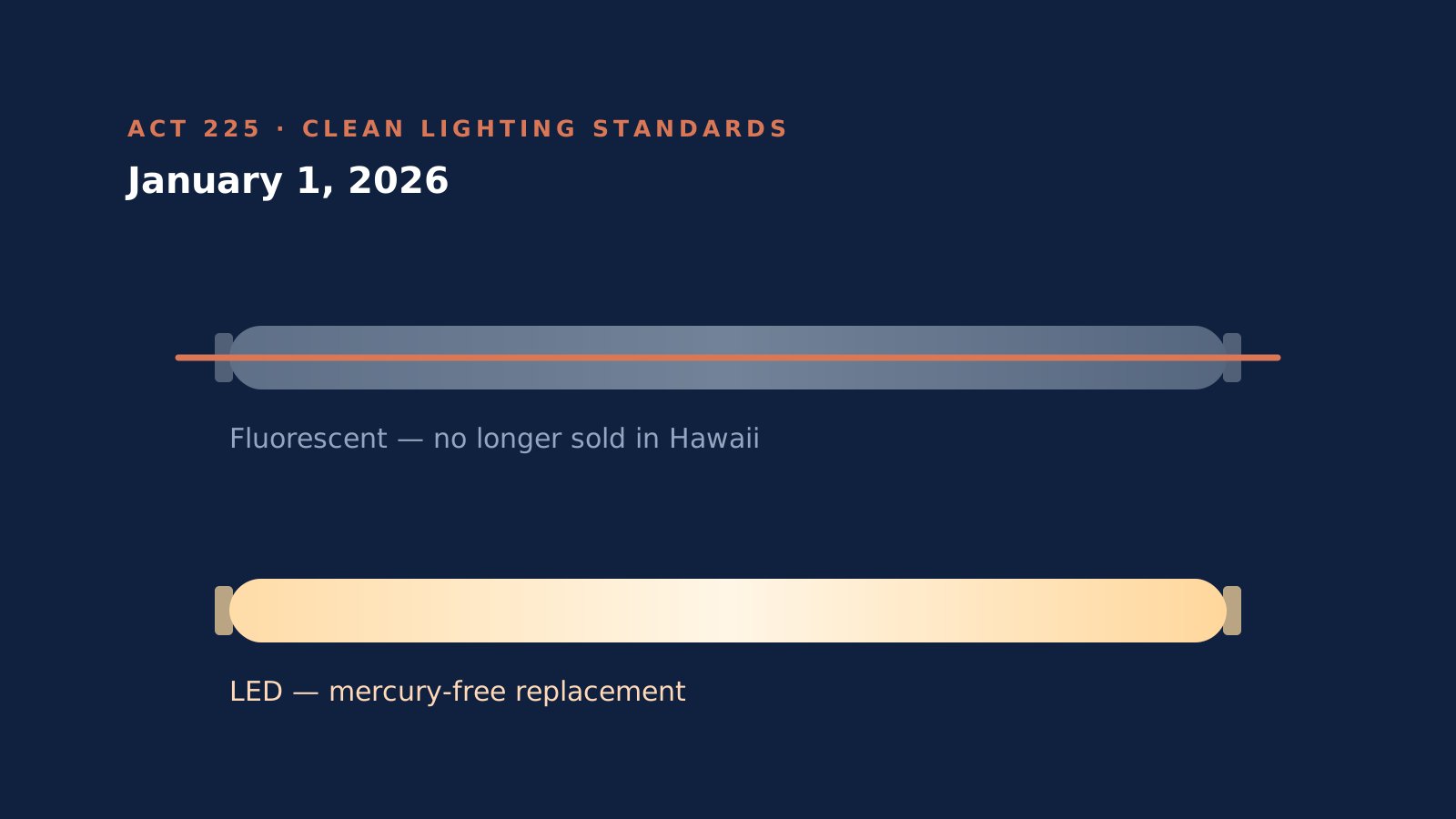
The short version
- January 1, 2025 — screw-base and bayonet-base CFLs could no longer be sold.
- January 1, 2026 — pin-base CFLs and all linear fluorescent tubes could no longer be sold.
- Still legal — using the fluorescent lamps you already own, for as long as they last.
What the law actually says
The law is Act 225, Session Laws of Hawaii 2023 — the Hawaii Clean Lighting Standards Act, signed on July 5, 2023. It makes it unlawful to sell, offer for sale, or distribute the covered lamps in Hawaii as new manufactured products.
Two things it does not do are worth saying plainly, because this is where most of the confusion sits. It does not ban using fluorescent lighting, and it does not require anyone to remove it. It is a sales restriction on new lamps, nothing more.
Which lamps are covered
The statute describes the lamps physically rather than by brand or part number. If a mercury discharge lamp fits the description, it is covered no matter who made it.
Linear fluorescent lamps
- Two end caps of any type — single-pin, two-pin, or recessed double contact
- Every tube diameter, including T5, T8, T10, and T12
- Lengths from 0.5 to 8 feet
- All shapes — straight, U-bend, and circular
Compact fluorescent lamps
- A single end cap of any type — screw, bayonet, two-pin, or four-pin
- Ballast built in or separate
- Any size or shape, directional or not
In practice that covers nearly every fluorescent lamp in a commercial building: the 4-foot T8s in troffers, the T12s still running in older warehouses, the U-bends in 2x2 fixtures, and the 4-pin CFLs in downlights and wall sconces.
What is exempt
Act 225 carves out a short list of specialty lamps. The exemptions cover lamps used for:
- Image capture and projection — photocopying, printing, lithography, film and video projection, holography
- High-UV purposes — germicidal lamps, disinfection and insect trapping, ozone generation, coral zooxanthellae, sunlamp products
- Medical or veterinary diagnosis and treatment, or use in a medical device
- Pharmaceutical manufacturing and quality control
- Spectroscopy and photometric work, including environmental monitoring
- Research projects and experiments at academic and research institutions
- Replacing a lamp in a previously manufactured motor vehicle
Most commercial and industrial buildings have none of these. Where it matters is a lab, a clinic, a print shop, or a facility running germicidal UV — worth checking before you assume a lamp is unavailable.
You do not have to pull out working fluorescents
Nothing requires you to re-lamp a building on a deadline. But there is a catch in waiting, and it is a real one: when a lamp burns out, there is no legal replacement to buy in Hawaii. Every burnout from here on is a conversion decision, and it arrives whenever the lamp decides — usually in an occupied space, on a day nobody planned for it.
That is the argument for planning the switch instead of absorbing it one fixture at a time.
Planning the conversion
Start with an inventory
Count what you have by lamp type and by how many hours a day it runs. A warehouse running 4-foot T8s sixteen hours a day is a different problem from a storeroom running the same lamp two hours a week. High-hour spaces pay for themselves fastest and also fail soonest.
Then pick a path per space
- LED tube (TLED) retrofit. Keep the existing fixture, change the lamp. Fastest and cheapest per fixture. Check whether the lamp is ballast-compatible, ballast-bypass, or hybrid, and confirm it matches what is actually in the fixture.
- New LED fixture. More labor, better result — current optics, better efficacy, a full fixture warranty, and the option to build in controls. The sensible choice when the housings are old, the lens is yellowed, or the layout was never right.
And order ahead
This is Hawaii. A part that has to come across the Pacific is a part you do not have for a week or more. Converting on a schedule means you can order to a schedule instead of paying for air freight on an emergency.
The rebates changed too
Because LED is now the baseline rather than the upgrade, Hawaii Energy retired a number of lamp rebates. Rebates are no longer offered for linear, troffer, U-bend, and pin-base lamps, recessed downlights, screw and GU-base omnidirectional lamps, candelabra and medium-base decorative lamps, or MR and PAR directional lamps.
What is still on the table:
- Standard rebates for corn cob lamps, exit signs, and occupancy sensors.
- Custom rebates for replacing operating fluorescents with LED, exterior fixtures such as wall packs, poles and floods, high bays, horticultural lighting, networked controls, and luminaire-level controls.
- Energy Advantage, which covers facility-wide upgrades at significantly subsidized rates for businesses, nonprofits, and restaurants of 5,000 square feet or less.
Important: Custom rebates require pre-approval before the purchase. Buy the fixtures first and the project is no longer eligible. If a rebate is part of your numbers, get the paperwork moving before the order goes in.
What to do with the old lamps
Fluorescent lamps contain mercury, which is the reason the law exists. They do not belong in the regular trash, and a full re-lamp generates a lot of them at once. Line up disposal before the work starts — your refuse hauler or the Hawaii Department of Health hazardous waste program can tell you what is required for your volume. LED lamps contain no mercury, so this is a problem you solve once.
Common questions
Are fluorescent lamps banned in Hawaii?
Selling them is. Under Act 225, screw-base and bayonet-base CFLs could no longer be sold as of January 1, 2025, and pin-base CFLs and linear fluorescent tubes could no longer be sold as of January 1, 2026. Using fluorescent lamps you already own is still legal.
Do I have to remove the fluorescent lighting in my building?
No. Act 225 restricts sales, not use. You can run existing fluorescent lamps until they fail. You will not be able to buy replacement lamps in Hawaii when they do.
Which fluorescent lamps does the Hawaii ban cover?
Linear fluorescent lamps with two end caps in any diameter, including T5, T8, T10 and T12, in lengths from 0.5 to 8 feet, in linear, U-bend and circular shapes; and compact fluorescent lamps with a single screw, bayonet, two-pin or four-pin base. A small set of specialty lamps is exempt, including germicidal and high-UV lamps, medical and veterinary lamps, and lamps used in spectroscopy or academic research.
Can I order fluorescent tubes online and ship them to Hawaii?
No. Hawaii Energy states that online vendors are subject to the same sales prohibition as in-state distributors.
Where this comes from
The statutory text and dates above come from Act 225, SLH 2023. The rebate details come from Hawaii Energy’s lighting ban FAQ and its business lighting rebate page. Rebate programs change; confirm current terms with Hawaii Energy before you commit to a number.
Converting a building?
Send us your lamp counts and we will tell you what the LED equivalent is, what we have in the Honolulu warehouse, and which parts of the job may qualify for a Hawaii Energy rebate. In-stock orders can be ready for will-call the same day, and we ship to all neighbor islands.
We’re a wholesale distributor, so we supply the licensed electricians, contractors and designers who do the work. Homeowners are always welcome to send their electrician our way — we’ll take good care of them.